
The CAC Trap: Why Your Growth Metrics Might Be Lying to You
- Anthony Talisic

- Oct 7, 2025
- 3 min read
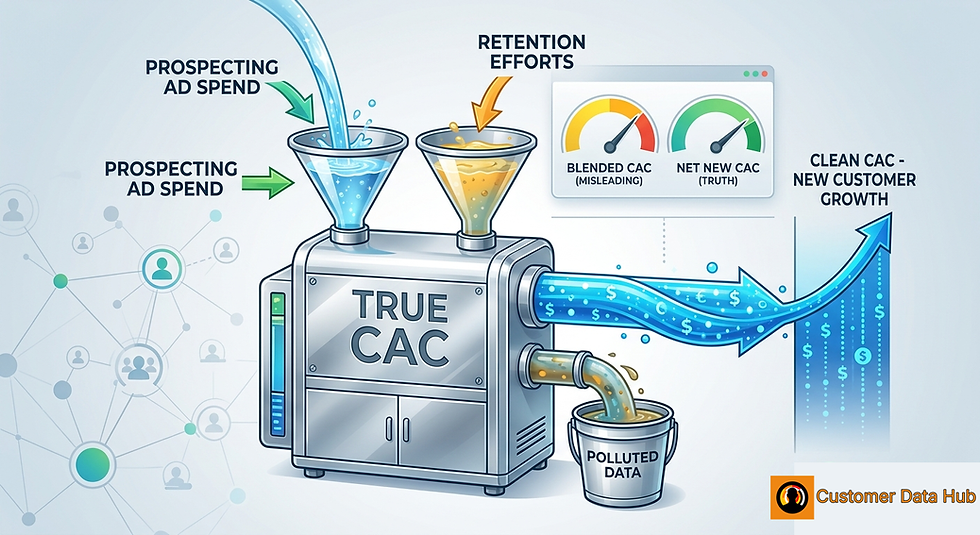
In the world of high-velocity retail, there is a number that keeps every CMO and Growth Lead up at night: CAC (Customer Acquisition Cost).
On paper, it looks simple. You spend $10,000 on ads, you get 1,000 orders, and your CAC is $10. Your dashboard turns green, your team celebrates, and you double the budget.
But at Customer Data Hub, we’ve seen what happens when you peel back the curtain on that $10. Often, the reality is far messier. If that $10 includes people who have bought from you three times before, you aren’t "acquiring" anything—you’re just paying a tax on your existing loyalty.
To build sustainable growth, you have to stop looking at broad averages and start looking at the granular truth.
What is CAC, Really?
At its core, CAC is the cost of a first-time relationship. It is the price you pay to turn a stranger into a customer.
Once that stranger buys from you, they transition from the "Acquisition" column to the "Retention" column. If your reporting doesn’t reflect this shift, your data becomes "polluted." You might think your Facebook ads are crushing it at a low CAC, when in reality, the algorithm is simply "cherry-picking" your existing customers who were going to buy anyway.
The "Clean CAC" Architecture
How do you ensure your growth metrics are empirical and untainted? You have to build a "moat" between your prospecting and your remarketing. Here is how we architect "Clean CAC" campaigns for our partners:
1. The Exclusion Moat
The most common mistake is a "leaky" funnel. To fix this, your prospecting campaigns must be physically unable to see your existing customers.
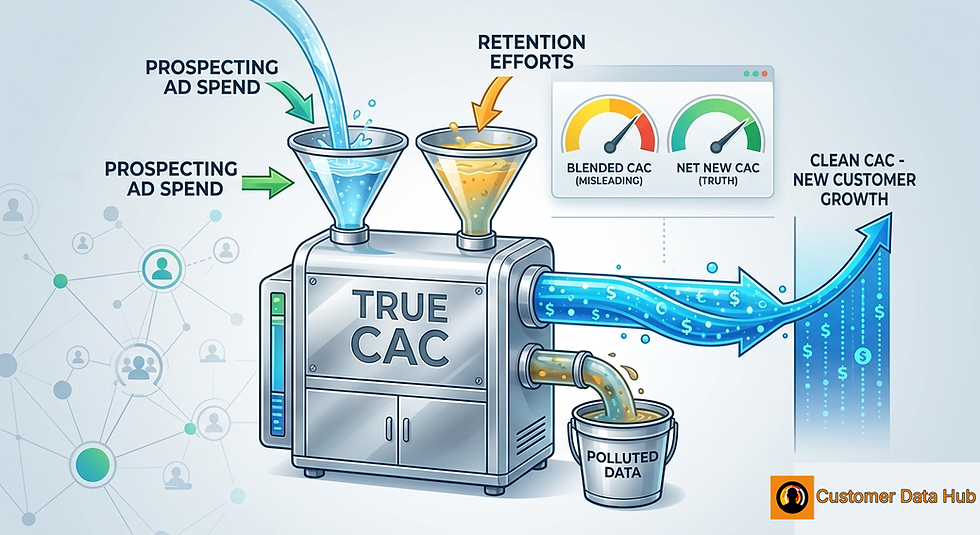
The CRM Sync: We don’t just rely on platform pixels. We sync your actual database as a "Negative Audience" in Google and Meta.
The Deep Exclusion: We exclude not just "past purchasers," but anyone who has visited your login page or engaged with your loyalty portal. If they know where your "Sign In" button is, they aren't a new acquisition.
2. Intent-Based Budgeting
Algorithms are designed to find the cheapest conversion. If you give an AI tool (like Meta’s Advantage+) a broad goal, it will naturally gravitate toward your existing fans because they are easier to convert.
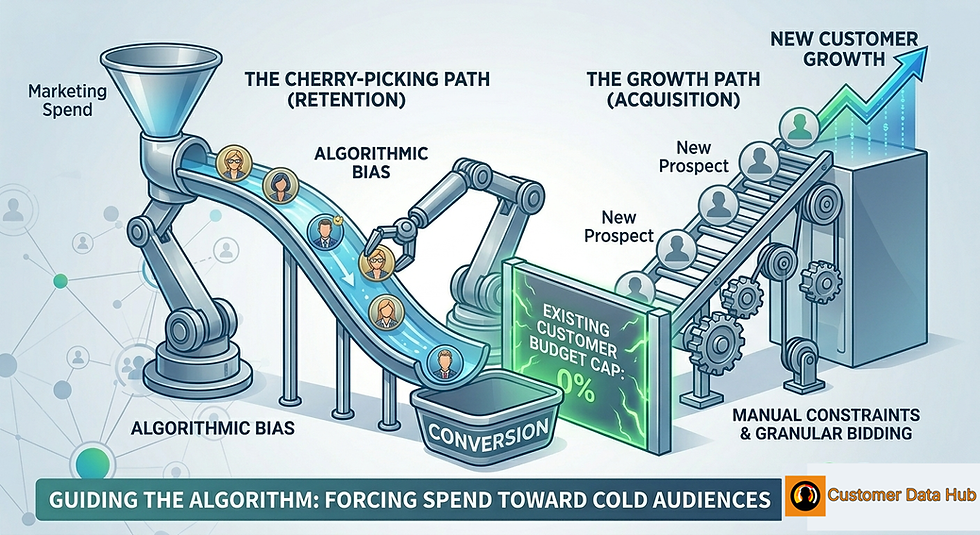
The Fix: Set strict budget caps on "Existing Customers" within your shopping campaigns. Force the spend toward the "cold" audiences where the true growth happens.
3. First-Order Logic

Your ad platform might claim a win, but your backend is the Source of Truth. At Customer Data Hub, we advocate for First-Order Attribution. * Divide your total Prospecting Spend only by the number of customers whose "Created Date" in your CRM matches that specific month. This gives you a Net New CAC—the only metric that actually tells you if your business is expanding.
The Halo Paradox
We often hear: "But Mark, if I stop showing ads to my existing customers, my total revenue might drop!"
This is the Halo Paradox. Yes, your blended ROAS might look lower, but your business health will be higher. By isolating your CAC, you finally see the true cost of scaling. You move away from "buying" your own customers and start investing in the "why" behind new transactions.
Loyalty isn’t a Program; It’s a Result
If you find your CAC is rising, the answer isn’t always more ad spend. It’s often better data. When you understand the granular motivations of your best customers, you can build lookalike models that actually work, rather than just casting a wide, expensive net.
Growth is only sustainable if it’s evidence-based. Is your CAC telling you the truth, or just what you want to hear?
The Architects of Growth
At Customer Data Hub Inc., we believe that the customer is the only source of sustainable growth. Based in Canada, we act as a nimble extension of your team, bridging the gap between "Big Data" and actionable business intelligence specifically for the North American retail landscape. Our mission is to move beyond broad averages and technical jargon to uncover the empirical "why" behind every transaction. Whether we are refining your CRM strategy or helping you architect a "Clean CAC" model, our methodology is rooted in the science of customer behavior to ensure that as your data grows, your understanding of your customer becomes sharper. Let’s build a customer-centric future together.


